How Dogs Came Indoors and Became Family Dogs
How dogs came indoors reflects varied household routines, helping you see how a dog can belong fully without access to every room or a single ideal setup.
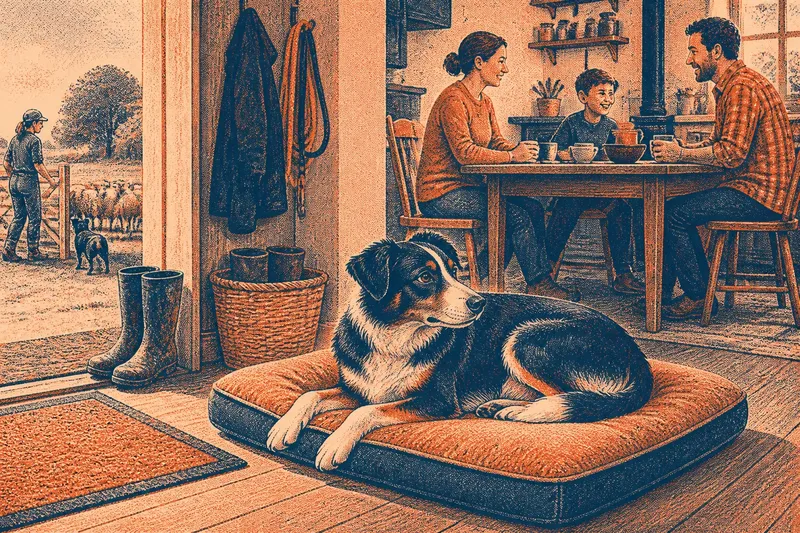
How dogs came indoors depends on the household and its work, not on one universal turning point. A dog that helped move livestock might rest near a barn, while a dog in a crowded home might share a warm room with its people; both could be valued members of the household.
There is no simple timeline that fits every place or family. Dogs’ roles and sleeping arrangements varied with local customs, climate, housing, and the tasks people expected them to do. That context makes today’s arrangements easier to understand without treating one indoor setup as the measure of care.
Work and proximity
People have kept dogs for many purposes, including hunting, guarding, and tending livestock. A dog’s daily work could shape where it spent time: a dog accompanying a shepherd might stay near the flock, while one alerting people to activity around a shop could remain close to the building.
Outdoor work did not necessarily mean a dog was unimportant or unwelcome. People could rely on and care deeply for a dog whose main resting place was a yard or work area. In those settings, companionship might grow through shared tasks rather than indoor lounging.
Imagine a fictional farm household whose dog helps move sheep between fields. The family brings the dog into the kitchen after work, then guides it to a sheltered bed by the barn; the observable result is shared time indoors alongside a regular outdoor resting place.
Homes and daily routines
Housing can influence where a dog settles. A home with a mudroom and a covered yard offers different options from a small home where the family shares one main room. Floors, household tasks, and the dog’s comfort can all inform a routine.
Some families may use a porch or entryway as a transition space. A dog can come inside after outdoor activity, settle while people are nearby, and return to a designated spot when the kitchen is busy. The point is not to recreate one historical pattern, but to make the arrangement clear and comfortable for everyone.
Say a household has a narrow entryway and a dog that tracks in mud after walks. The family places a washable mat and a dog bed in a nearby corner, wipes the dog’s paws before it enters the kitchen, and keeps the doorway clear. The expected result is a predictable place to pause without blocking the route through the home.
Companionship at home
Dogs can be valued for work and companionship at the same time. When a dog spends more of its day near people, ordinary shared moments—resting while someone reads or waiting nearby during a meal—can become part of the household routine.
Indoor access still involves practical choices. A family might decide where the dog eats, sleeps, and waits while people are out. Some rooms can remain off-limits, as long as the dog has a comfortable place to rest and the people in the home can follow the routine consistently.
What shapes indoor life?
Did dogs always sleep inside?
No single sleeping arrangement applied to every dog or household. Work, climate, housing, and local customs could all affect where a dog rested.
Could an outdoor working dog belong to a family?
Yes, a dog could be closely valued while spending much of its time outdoors or near the animals it worked with. Family attachment and access to every indoor room are separate questions.
Why might a dog spend more time indoors?
A household’s work and daily routines can shape how much time people and dogs spend together. When a dog no longer needs to remain near a task for much of the day, there may be more opportunities for shared time at home.
Does an indoor dog need access to every room?
No. A household can set room boundaries while giving a dog a suitable resting place and a predictable routine. The arrangement should work for the people and the dog sharing the home.
Household routine checks
Before settling on a dog’s place at home, check how the space works during ordinary activities. Each observation points to a practical choice:
- Check whether the dog’s resting spot is repeatedly interrupted; if it is, move the bed to a quieter area, and if it is not, keep the spot available.
- Check whether the dog blocks a doorway or walkway; if it does, relocate the bed, and if it does not, leave the route open as it is.
- Check whether the floor near the resting spot is slippery; if it is, add a nonslip mat or choose another area, and if it is not, keep the current surface.
- Check whether cooking or meal preparation makes the kitchen too busy for the dog; if it does, set a resting place outside the work area, and if it does not, maintain the existing routine.
- Check whether everyone in the home follows the same room boundaries; if they do not, agree on a consistent rule, and if they do, continue with that rule.
- Check whether visitors or household noise disturb the dog; if they do, offer a quieter retreat, and if they do not, keep the current arrangement.
For example, imagine a dog’s bed sits beside a hallway door, and people keep stepping around it when guests arrive. The household checks the traffic path, moves the bed to a quiet corner of the family room, and asks visitors to leave that spot clear. The result to look for is an unobstructed doorway and a place the dog can use without being jostled; if guests still pass too close, the family can choose a different quiet corner.
Belonging without one model
The history of dogs at home does not point toward one correct lifestyle. Dogs’ roles, housing, and household customs have differed, and they still do. Some dogs spend much of their day outdoors for work; others share indoor routines, and many move between the two.
A dog’s place is not measured only by whether it sleeps in a bedroom or has access to every room. Care can also show in a reliable routine, a comfortable resting place, and attention to the dog’s needs. How dogs came indoors is best understood through those varied relationships between work, home, and companionship.
Notice one daily transition: where your dog settles after coming inside. If that spot is comfortable and does not interrupt household routines, keep it consistent; if it causes crowding or repeated disturbance, adjust the location and watch whether the new arrangement works better.