The Friendly-Dog Assumption: Let a Greeting Have Room
Dog greetings go better when nobody assumes an approach is welcome. Learn to create space, read the response, and let each dog choose whether to meet.
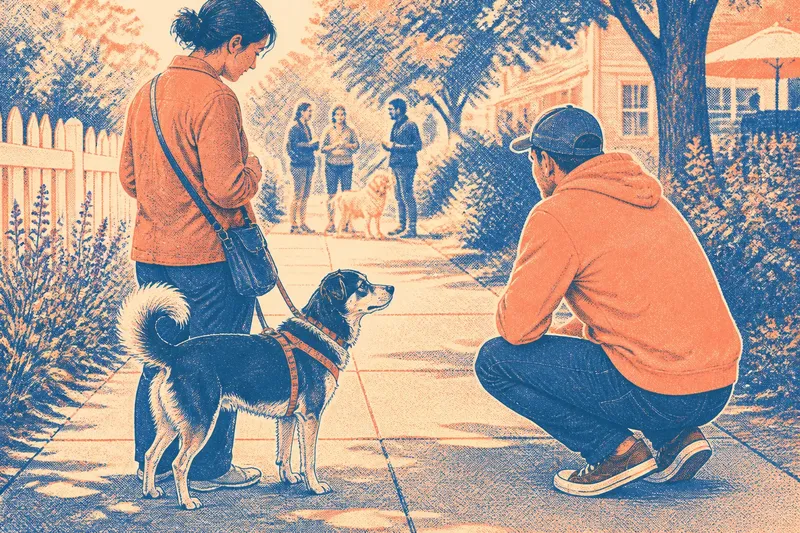
A dog can look friendly and still not want a stranger’s hand in their face. A considerate dog greeting starts with space, not an outstretched palm. When people assume every dog wants to say hello, a simple encounter can turn tense for the dog, the person, or both.
That assumption often comes from familiar signals: a wagging tail, a soft-looking face, or a dog standing near their person. But no single signal tells you the whole story. The dog may be excited, uncertain, focused elsewhere, or simply comfortable watching from a distance. The goal is not to decode every movement perfectly. It is to make room for the dog to show what they prefer.
When the approach is assumed
Problem: Someone walks straight up and reaches toward the dog before asking. What may be behind it: People often treat a dog’s presence in public as an invitation, especially if the dog appears calm. But being near a person is not the same as seeking contact.
Try this first: Pause at a comfortable distance and ask the handler whether a greeting is welcome. If the answer is no, or the handler seems unsure, keep moving without asking the dog to prove anything. If the answer is yes, let the handler decide whether the dog is ready to approach.
Asking the person is a useful first check, not permission to crowd the dog. A handler may agree in principle while their dog is busy, tired, or uneasy in that moment. Leave a clear path for the dog to move away.
Keep your hands to yourself until the dog has had a chance to choose contact.
When the dog seems eager
Problem: A wagging tail or a dog pulling toward someone is read as a request to be touched. What may be behind it: A wag can accompany several kinds of arousal, and pulling can reflect excitement or frustration as well as social interest. The movement alone does not settle what the dog wants.
Try this next: Stay still or angle your body slightly sideways, then give the dog a moment to look and decide. Avoid leaning over them, staring into their eyes, or making a sudden reach. If the dog comes closer with a loose body and continues to seek interaction, the handler can help keep the meeting calm.
Imagine a dog named Miso standing beside their person at a neighborhood gathering. A visitor asks the handler, waits a few feet away, and turns slightly sideways. Miso looks over, sniffs the air, then steps closer; the visitor stays still while Miso briefly sniffs their hand and moves away. The useful result is not a longer petting session. It is a greeting that ends when Miso chooses to leave.
If the dog does not approach, that is a complete answer. Don’t coax, call, or follow them to secure a greeting.
When the signals are mixed
Problem: The dog comes closer, then turns their head, licks their lips, freezes, or shifts away. What may be behind it: A dog can be curious and uncomfortable at the same time. A brief approach does not mean they want continued contact, and small signs of tension can be easy to miss when everyone is focused on saying hello.
Try this: Stop reaching and create more space. Let the dog’s handler guide them, and do not block their route or ask them to stay. If the dog returns freely after a pause, the handler can decide whether another brief interaction makes sense. If the dog keeps turning away or moving off, end the greeting.
Look for the pattern, not a single gesture. A relaxed dog may move naturally, sniff, and disengage without being pursued. A dog who goes still, repeatedly avoids contact, or leans away is giving you a reason to pause. These observations are not a diagnosis; they are enough to guide a kinder choice.
When you are unsure, make the interaction shorter and give more room.
When the setting adds pressure
Problem: A greeting happens in a doorway, on a narrow sidewalk, or while the dog is held close on a short leash. What may be behind it: The dog may have little room to approach or retreat, and a person standing nearby can make that constraint feel stronger. Even a dog that enjoys meeting people may find a tight space difficult.
Try this before introducing anyone: Move to a quieter, more open spot if the handler can do so comfortably. Keep the visitor from surrounding the dog, and avoid asking the dog to squeeze between people. If the location cannot be changed, skip the greeting and let the dog pass.
Children need especially clear guidance. Ask them to stay beside you, keep their hands down, and let the dog’s handler manage any interaction. Don’t encourage a child to hug, kiss, or put their face near a dog’s face, even if the dog belongs to a friend. A gentle hello can be watching quietly from a respectful distance.
When a greeting is declined
Problem: The handler says the dog cannot greet, or the dog moves away, and someone keeps trying. What may be behind it: A person may take the refusal personally or assume that one more invitation will help. But a dog does not owe strangers contact, and repeated coaxing can turn a clear boundary into pressure.
Try this instead: Accept the answer with a simple “No problem,” then give the dog room to continue what they were doing. Don’t ask for a reason or offer treats without the handler’s agreement. Some dogs have routines, training needs, or sensitivities that are not visible to passersby.
Giving space is not a judgment about the dog or the person. It lets the handler manage their dog without having to explain private details, and it lets the dog remain comfortable in a shared place.
Greeting questions answered?
Should I offer my hand for a dog to sniff?
Not automatically. Ask the handler first, then let the dog approach if they choose; keep your hand relaxed and avoid placing it near the dog’s face.
Does a wagging tail mean a dog wants to meet?
No single tail movement answers that question. Consider the dog’s whole posture and what they do when given room, and stop if they turn away or seem tense.
What if the dog approaches me?
Stay calm and let the handler guide the interaction. The dog’s approach may be a brief check-in, so wait for continued, relaxed interest rather than reaching out at once.
Can I let my child greet a dog?
Only with the handler’s permission and close adult guidance. If the dog cannot move away freely or the child cannot follow calm, gentle boundaries, skip the greeting.
A calmer kind of hello
Dog greetings do not need to end in petting to count as polite. A pause, a glance, or a dog choosing to keep walking can be a perfectly good exchange. The friendly-dog assumption fades when people treat contact as an option rather than a debt.
For your next encounter, ask the handler, leave a clear way out, and watch what the dog chooses to do. That small change makes a dog greeting more considerate—and gives the dog the final say about closeness.